How to Organize Your Fridge for ADHD
You bought the spinach with real intent. You had a plan for it. Then it slid behind the oat milk, the plan went with it, and ten days later you found a bag of green soup. That's the ADHD tax in its purest form: groceries bought on purpose, thrown out with guilt.
If you're searching for how to organize a fridge for ADHD, you probably don't need another photo of a magazine fridge with labelled acrylic bins and twelve matching lemons. You need a fridge that does the remembering for you, and a setup that survives a bad week. That's what this guide is about. Nothing here asks you to become a different person. It just moves the food to where your brain already looks.
Why the normal fridge layout works against you
Fridges are designed around storage, not attention. The crisper drawers are at the bottom, opaque, and closed. The deep shelves let things migrate to the back. The door, the one spot you see every single time, is full of condiments you use twice a year.
For a lot of ADHD brains, out of sight really is out of mind. Not “sort of forgotten”: gone. So a standard layout quietly guarantees that the most perishable food ends up in the least visible places. That's not a willpower problem. It's a design problem, and design problems have design fixes.
The core idea: flip the fridge
The single change that does the most work is inverting the usual layout. Put the food that goes bad fastest where your eyes land first, and push the food that lasts for weeks into the places you never look.
Eye level: the eat-first zone
Pick one shelf, the one at your eye line when the door opens, and make it the eat-first zone. Leftovers, opened packs of meat, cut fruit, herbs, the half avocado, anything with a clock on it lives here and nowhere else. If it's on this shelf, it's next. If you open the fridge wondering what to eat, the answer is on this shelf.
The crisper drawers: long-haul stuff
Here's the counterintuitive part. If vegetables keep dying in the crisper, stop putting vegetables in the crisper. Use the drawers for things that don't need watching: sealed drinks, backup cheese, jars, butter, the second bottle of hot sauce. Put the produce you actually want to eat in clear containers up top, where you'll see it.
The door: grab-and-go
The door is the one spot you see every time. Give it to the things you want to reach for without thinking: yogurt cups, string cheese, hummus, ready-to-eat snacks. If the goal is “eat the food we have instead of ordering,” make the food we have the easiest thing to grab.
Make everything visible
Visibility beats tidiness every time. A messy fridge where you can see everything works better than a neat one where things hide.
- Clear containers, always.Opaque tubs are where leftovers go to be forgotten. If you can see the curry through the lid, you'll remember the curry exists.
- One row deep where you can. Anything behind something else is effectively invisible. A turntable on one shelf helps for jars and sauces, because a spin shows you everything.
- Bins as categories, not as lids.An open bin for “breakfast stuff” or “snack stuff” means you grab the bin and see it all at once. A bin with a lid is just a smaller, darker fridge.
- Skip the label maker (unless you love it).Labels are nice. They're also a setup task that has to happen before the system works, which is exactly the kind of step that stalls. Start without them.
One rule for leftovers
Systems with lots of rules die fast. Keep exactly one rule for leftovers and make it easy to follow: everything cooked goes into a clear container on the eat-first shelf, and it has a few days to get eaten or frozen.
The numbers come straight from the USDA's food-safety agency. According to the FSIS page on leftovers and food safety, leftovers keep 3 to 4 days in the refrigerator or 3 to 4 months in the freezer, and cooked food should go into the fridge within 2 hours (1 hour if it's above 90 °F). FSIS also says to divide big batches into shallow containers so they cool quickly, and that the safe fridge temperature is 40 °F or below.
If remembering dates is the hard part, don't try to remember them. Write the day on the lid with a dry-erase marker, or use a simpler trick: Sunday's leftovers go on the left, Wednesday's on the right. Whatever's on the left by Wednesday gets eaten, frozen, or let go. For a longer cheat sheet, here's how long common leftovers last.
Make maintenance tiny
The best fridge setup for ADHD is the one that still works after a rough week. So the upkeep has to be small enough to do on a low-energy day.
The two-minute sweep
Once a week, ideally right before groceries, do a two-minute sweep: open the fridge, pull anything that's past saving, and move anything close to its end onto the eat-first shelf. That's it. Not a deep clean. Not wiping shelves. Two minutes, and if you skip a week, the system still mostly works.
Anchor it to something you already do
New habits stick better when they ride on old ones. Do the sweep while the kettle boils, or every time you put the grocery bags on the counter. The trigger is the routine you already have, not a reminder you'll swipe away.
Let go of the guilt
Some food will still go bad. That's fine. The goal isn't a perfect fridge; it's throwing less money in the bin than last month. Every saved meal counts, and the ones you lose aren't a verdict on you.
The other half: deciding what to cook
Here's the thing nobody mentions in fridge-organizing guides. You can have a beautifully visible fridge and still stand in front of it at 6pm with a fridge full of food and nothing to eat. Seeing the food is step one. Turning chicken, half a pepper and some rice into dinner is a decision, and decisions are expensive at the end of a long day.
So lower the cost of the decision too:
- Keep three default mealsthat use whatever's on the eat-first shelf: a fried rice, an omelette or frittata, a wrap. When you can't decide, you pick one of three, not one of everything.
- Let a tool do the search.Type what's on the shelf into the Custrd recipe finder, which is free on the web with no signup, and it searches thousands of recipes for ones you can make with what you have.
- Browse when you have energy, cook when you don't. Save a few recipes from the Custrd recipe library on a good day, so a bad day only needs you to follow steps.
Where Custrd fits
The honest problem with fridge inventory apps is that they want you to type everything in by hand, and that's exactly the kind of task that gets abandoned by week two. We wrote about why manual fridge tracking dies if you want the long version.
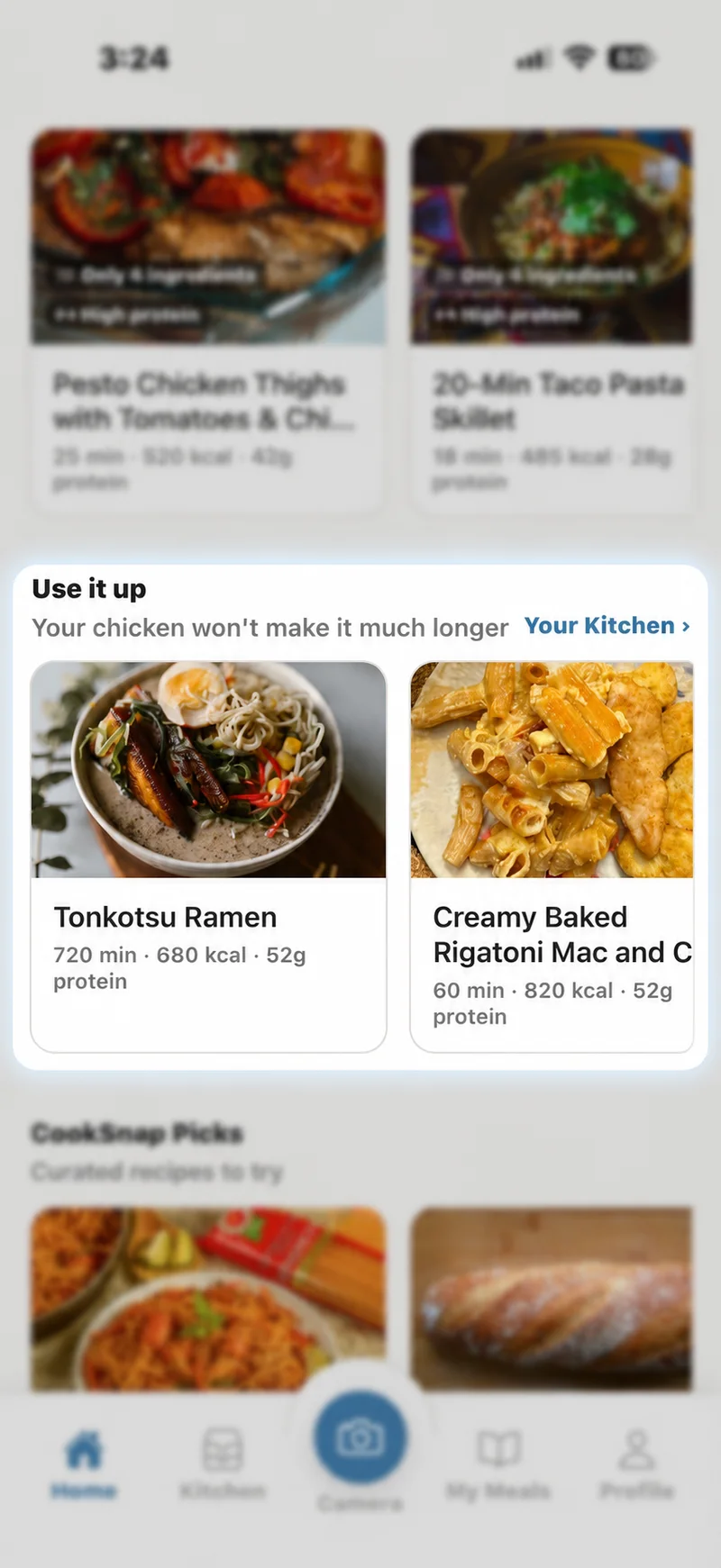
Custrd flips the direction of the work. You point your phone camera at the fridge because you want dinner ideas, and the scan also updates your Kitchen, a digital copy of your fridge and pantry. Each item gets a shelf-life estimate (days for milk, weeks for potatoes, all editable), and anything running out of time lands in a “Use soon” list. On the home screen, a “Use it up” row suggests real meals built around the thing that's about to turn, like the screenshot at the top of this post. It's the eat-first shelf, except it reminds you, and it comes with a recipe.
That's the part a physical fridge can't do: it can show you the chicken, but it can't tell you the chicken has one day left and here are three dinners that use it. If cutting waste is the main goal, the food-waste side of Custrd explains the rest.
The short version
If you only do one thing from this guide on how to organize your fridge for ADHD, make it the eat-first shelf: perishables at eye level, long-lasting stuff in the drawers, everything in clear containers. Add one leftovers rule and a two-minute weekly sweep, and you've built a fridge that remembers for you. Then make the deciding cheaper, because a visible fridge only pays off when the food in it turns into dinner.
Try Custrd free for 7 days on iPhone. It's on Android too.